August 6, 2010 -- Updated 0754 GMT (1554 HKT) 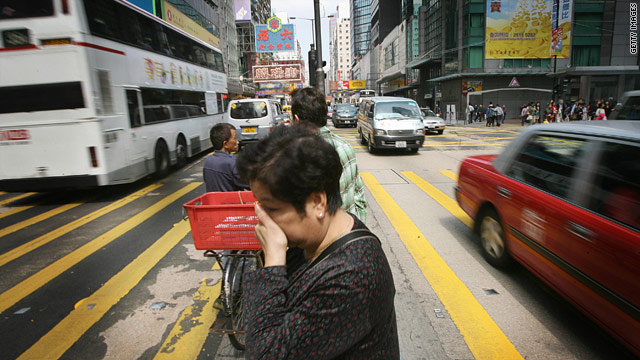 Urban pollution continues to grow despite stricter regulations in many cities. Could a solution lie at ground level? (CNN) -- Concrete isn't usually considered an environmentalists' friend, but a remarkable new technology could soon be turning the gray stuff green. Scientists at Eindhoven University of Technology in the Netherlands have developed a paving material that actually eats pollution, claiming it could soon become a crucial tool for improving air quality in urban areas. The problem in many cities is that vehicle exhausts emit nitrogen oxides, which cause acid rain and smog that damages not only human health and quality of life but also the fabric of buildings. But the new concrete is coated with titanium dioxide, which is a photocatalytic material, meaning it removes the nitrogen oxides and uses sunlight to convert them into harmless nitrate that is washed away by rain. Air regulations are becoming stricter, and in many busy streets the air quality standard is still failing. Titanium dioxide is already commonly used to coat surfaces that are hard to clean -- it is a component in some paints -- because it functions as a self-cleaning chemical, meaning the new concrete has the additional advantage that it breaks down algae and dirt so its surface stays clean."In our tests we have found nitrogen oxide reductions of 35 to 40 percent in areas paved with the new concrete," Professor Jos Brouwers of the Department of Architecture, Building and Planning at Eindhoven University of Technology told CNN. Brouwers' discoveries are part of a race to explore new ways of using new technology to mitigate pollution. Chinese researchers are believed to be experimenting with nanotech polymers to coat exhaust pipes, and others across the world are experimenting with titanium dioxide. Following extensive laboratory tests the pollution-eating concrete has now been trialed in the Dutch town of Hengelo, where 1,000 square meters of the road's surface were covered with air-purifying paving stones. As a control, another area of 1,000 square meters was surfaced with normal concrete paving slabs. Samples were then taken from the air at between 0.5 and 1.5 meters above the surface. "The air-purifying properties of the new paving stones had already been shown in the laboratory, but these results now show that they also work outdoors," said Brouwers. "[The concrete] could be a very feasible solution for inner city areas where they have a problem with air pollution. We will continue measuring to the end of the year because the authorities need to be convinced it is a feasible technology. "Air quality is an important issue and they know it is something important to consider." The paving slabs used in the tests have been made by, and co-developed with, manufacturer Struyk Verwo Infra, and are already available for use. But the applications of the technology are not limited to paving. Where an asphalt surface is required, the concrete can be mixed with normal asphalt and, according to Brouwers, it can also be used to make walls. "You can apply it very easily in the normal production," says Brouwers. "It doesn't require any maintenance; it doesn't wear off with normal use." Predictably the material is around 50 percent more expensive than normal concrete, but Brouwers is adamant that when the total cost of fitting is included, the overall increase in cost is only 10 percent. "Sure, it is slightly more expensive, but if you look at the total pavement costs where the stone is one part -- there is also labor, foundations etc. to calculate -- then you are only looking at a slightly higher cost," he says. Some may argue that it is more important to try and tackle pollution at the source rather than mitigate its effects. But Brouwers sees the new concrete as a pragmatic response to a very real problem -- a second line of defense -- and one element in a suite of measures that should be adopted to improve air quality in our cities. "Cars are subject to more and more stringent regulations all the time, and they are becoming cleaner; so are factories," he says. "But at the same time air regulations are becoming stricter and stricter and in many busy streets the air quality standard is still failing, so [the concrete] is a valuable addition. "Of course you have to treat [pollution] at the source, but standards are so strict now and air quality regulations are still not met, so [the concrete] can be useful." |

Showing posts with label Environmental Issues. Show all posts
Showing posts with label Environmental Issues. Show all posts
Saturday, September 4
Could pollution-eating concrete clean up our urban jungles?


Thursday, May 13
Why Is the Oil Spill Orange?
Plus: If oil has to be pumped out of the ground, why is it spewing into the Gulf on its own?
Posted Tuesday, May 11, 2010, at 7:28 PM ET The leaking well off the coast of Louisiana hasspilled more than four million gallons of oil into the Gulf and continues to gush at a rate of 210,000 gallons per day. Why is this particular well spewing forth so prolifically, while in other places we have to pump oil out of the ground ourselves?
Because it's under a lot of heavy rocks. Deep deposits, like those in the Gulf, are packed down very tightly by the rock column above them. If they are tapped carelessly, the oil will start to gush out all at once, Beverly Hillbillies-style. Deposits that are closer to the surface are under less pressure, and the oil may need to be pumped from the very first drop. Almost all wells need a little help eventually, as extraction diminishes their internal pressure. Engineers pump water or natural gas into the chamber to force out the remaining crude, which is later separated from the added fluids.
Gulf wells are even more likely to gush than you'd expect, given their depth. Most of them formed under tremendous pressure, far beneath the earth's surface, but a subsequent geologic disturbance has pushed them up to their current location, at 20,000 feet. To control the flow of oil from wells like these, companies pack their drilling hole with a thick, heavy fluid known as drilling mud that maintains pressure on the reservoir. The clay and mineral compound helps prevent blowouts like the one that's now flooding the Gulf.
Even some shallow wells are under enough pressure to make it to the surface without human intervention. Native Americanscollected seeping oil to waterproof baskets and caulk boats. Settlers used it to grease their wagon wheels as they rolled along the Oregon Trail. The first commercial oil well, drilled in Titusville, Penn., by Edwin Drake in 1859, was located based on natural seeps. Many of the significant deposits in Texas and California have been found the same way.
Marine seeps are even more common. A single leak near Santa Barbara releases around2,500 gallons of crude into the Pacific every day. Natural seeps account for 46 percent of the hydrocarbons in our oceans.
Bonus Explainer: Why does the oil slick appear to be orange instead of black? Because the emulsion of oil in water consists of particles of many sizes, separated by water molecules. The way these particles scatter light (and produce color) depends on their size, and their size can change over time as they clump together or separate.
Paul Sabin chronicled Big Oil's habit of fighting safety regulations. Nina Shen Rastogi offered an update on efforts to clean up the Exxon Valdez spill. Daniel Engber explained how to mop up spilled oil. Christopher Beam answered your questions about the Gulf spill.
Oil isn't always black, even when it hasn't been mixed with water. Crude oil—that's the unrefined stuff that comes out of the well—can be transparent, yellow-green, reddish, amber, brown, or black, depending on its composition. So-called "light crude," in which the hydrocarbons are mostly free of contaminants, tends toward the lighter end of the scale (naturally). Heavy crude often takes a dark brown or black color on account of the metals mixed in.
Got a question about today's news? Ask the Explainer.
Explainer thanks Christine Ehlig-Economides of Texas A&M University and Michael J. Economides of the University of Houston. Thanks also to reader Brian Colfax.
========================
Tuesday, September 29
Still, flood
Dr. Prisco Nilo, head of PAGASA, says people should stop watching soap and start listening to news. As early as Thursday, he said, PAGASA was airing warnings of possible flooding and even raised storm signals the following day.
Well, the advice is sound, but not for the reasons Nilo adduces. People should really stop watching soap and start listening to news—to improve their minds. Not to get wind of the weather situation. The only thing that has become more fickle than the weather in this country is its weather forecast. People would be heeding PAGASA’s warning more if the sun did not shine on days it predicts will be stormy, thereby sending hordes of kids on holiday to Trinoma and SM North, and thereby adding to the Ayalas’ and Sys’ coffers. And if rains did not lash on this earth on days it predicts will be agreeable, thereby stranding kids at school who are hard put to find a ride home, and thereby getting their bedraggled working parents in a worse state of bedragglement waiting for them.
Didn’t PAGASA report some months ago that the rainy season had officially begun only to see some of the hottest days visit the country for weeks on end? And didn’t PAGASA say the dry season was making a comeback only to see the rains barging in? Maybe folk listened to the news and heard only the boy who cried wolf. “Weather-weather lang ’yan” doesn’t just apply to this country’s politics, it applies to its weather, too. Or its weather forecast.
It cannot help improve PAGASA’s credibility that it says things like “Ondoy” dumped more rains on this country than “Katrina,” a thing Arroyo has been citing all over the place to suggest that Metro Manilans should blame God and not she for their travails. I don’t know if that’s true, but even if it were, what of it? What caused the flooding in New Orleans was not the volume of rain, it was the fury of the tempest. Lest we forget, Katrina was a hurricane. Its force, which gathered strength as it neared New Orleans (Al Gore would point to it as a strong case for climate change, the storm’s wind velocity jumping wildly as it encountered warm air) was such that it broke the levees and sent tons of water tumbling into the place. That was what caused the floods.
There was no such gale last Saturday. Only one unrelenting downpour for a whole day, which is nothing compared to the 40 days and 40 nights of rain that poured on Luzon in July and August of 1972. For it to have caused the catastrophe it did, we do not have heaven to blame for that. We have Le Cirque to blame for that.
We have the billions that should have gone to improving Metro Manila’s drainage system and shoring up its dams but which have gone instead to feeding insatiable appetites, which is not entirely figurative, to blame for that. We have the billions that should have gone to procuring rubber boats and other rescue vessels to save lives and give relief during dire times but which have gone instead to flying public officials to watch Manny Pacquiao fight in Las Vegas to blame for that. We have the billions that should have gone to disaster preparedness but which have gone instead to preparing a lame candidate carry out a disastrous campaign to blame for that.
But PAGASA has a point when it says global warming has made the weather a lot more unpredictable, even if that very argument cannot augur well for its continued existence. The weather has become unpredictable, which is of tremendous concern for everyone of us, not just government. The best government may not spare us of its effects, however it may drastically lessen their direness.
Before Ondoy hit, I was just telling someone the weather was scaring the hell out of me. It wasn’t just that summer, or what used to be so, brought torrential downpours and the rainy season, or what used to be so too, brought infernally hot days. It was also that in one single day you would have winds blowing like crazy on a warm sunshiny day, which was perfectly all right with me, followed by lashing rain and humidity hours later, which was perfectly maddening for me. I made the mistake of leaving my umbrella in my car coming home one late afternoon to the first and going out in early evening to the second.
Weather may be fickle, but it’s never been this fickle. Certainly not so on a sustained basis. Looking back, the floods last Saturday were an accident waiting to happen. Infanta was buried in mud and rock in December 2004 from rainfall that loosened a mountain, just a week or so before a killer tsunami flattened Aceh and environs. A super storm ripped through Albay three years later turning the place into a wasteland, leaving only the roofs of houses peeping out in some places. A lot of folk have left, the ones that have remained are in constant fear at the first sign of rainfall that the volcanic ash at the foot of Mayon would turn into a putrid flood and overrun their dwelling places again. Why should we imagine that Metro Manila would be spared these devastations?
It is no small irony that Odette Alcantara died earlier last week, before the floods hit Metro Manila. She had been an ardent campaigner for the environment, warning of the dangers we courted with our continuing deafness to the cries of Nature. As Saturday abundantly showed—to residents of Metro Manila, if not to those of Infanta and Albay—that is not just the concern of people who have nothing better to do than hug trees. That is the concern of everyone. Doubtless we cannot solve global warming alone, but neither can others do so that way. Being poor is no excuse to not do our part. As Saturday showed, there is nothing better to do than to save the planet. There are worse things than being poor. Being poorer is one of them.
Being dead is another.
=================
source: http://opinion.inquirer.net/inquireropinion/columns/view/20090929-227398/Still-flood
Subscribe to:
Posts (Atom)
